Understanding the UAP Organizations Ecosystem
You can find all of our UAP Organizations at our Directory of UAP Organizations .
The landscape of Unidentified Anomalous Phenomena (UAP) research is no longer confined to isolated eyewitnesses or classified government basements. Today, it is a rapidly growing ecosystem driven by a diverse network of organizations. Each plays a distinct role in peeling back the layers of mystery surrounding UAP.
To help make sense of this network, we categorize these entities into specific organization types. Understanding what these organizations do, and how they collaborate, is key to recognizing how the world moves closer to true scientific understanding and political disclosure. Note that some organizations may carry two designations. For instance, an organization that focuses on Investigative Reporting may also produce educational material.
The Network Effect
None of these categories operate in a vacuum. A Funding foundation might back a UAP Research project, which uses software built by a Tool Provider to analyze a trend identified by a Case Reporting hub—all while a Lobbyist group uses those final results to demand congressional action.
By organizing these entities into a single taxonomy, our hub page allows you to explore the exact mechanisms driving the modern disclosure movement forward.
You can find all of our UAP Organizations at both our UAP Organizations Hub and our UAP Organizations Archive Page.
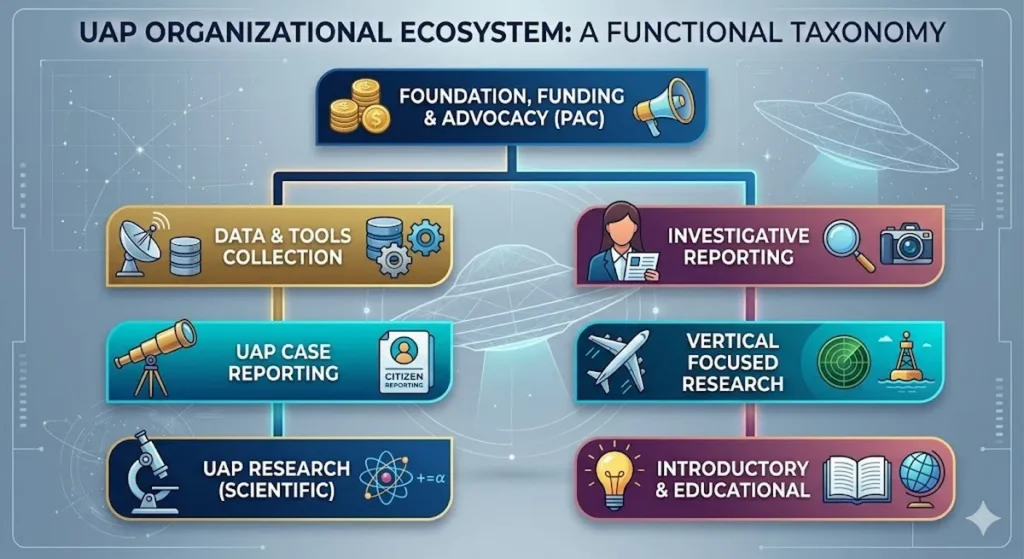
UAP Organization Types Taxonomy
UAP Research
These are the scientific and academic powerhouses of the community. Rather than relying on anecdotes, UAP Research organizations apply rigorous scientific methodologies, peer-reviewed standards, and advanced sensor data to analyze anomalies. Their value to the research process is foundational: they strip away the stigma of the subject by treating UAP as a legitimate field of empirical study, aiming to discover the physical traits and origins of these phenomena. Examples include Harvard University’s Galileo Project, The Scientific Coalition for UAP Studies, and the All-domain Anomaly Resolution Office (AARO).
UAP Case Reporting
Before data can be analyzed, it must be captured. UAP Case Reporting organizations act as the frontline intake valves for the public and witnesses. By providing safe, standardized platforms for military personnel, commercial pilots, and everyday citizens to log sightings, these groups ensure that vital raw data isn’t lost to time or fear of ridicule. They build the historical baselines that researchers rely on. Reporting Organization exist globally; our UAP Organizations Hub page has an extensive list. Examples include the National UFO Reporting Center (NUFOC), and the Mutual UFO Network (MUFON).
Investigative Reporting
Organizations primairly or partially focused on Investigative Journalism.
Introductory and Educational Material
Organizations primairly or partially focused on creating Educational UAP material.
Vertical Focused Organizations
Organizations focused on a specific vertical such as Americans for Safe Aerospace.
Foundations and Funding Sources
Foundations participate in such activities as grant-making, operating programs, advocacy, commissioning studies, publishing reports, hosting events, or promoting policy ideas aligned with their charter.
Lobbyists, Advocacy and Political Action Committees (PACs)
The advocacy arm of the UAP ecosystem.
Data and Records Collection, Tool Providers
Archivists, data repositories, providers of software and hardware tools