
No Longer in Shadows, Pentagon’s U.F.O. Unit Will Make Some Findings Public
This July 2020 New York Times article revealed the continued existence of a dedicated UAP investigative body within the military following the dissolution of AATIP.
You can find all of our Historic UAP News Records at our Historic UAP News Hub.
Understanding the modern UAP disclosure movement requires examining the journalistic record that brought it to light. For over seventy-five years, reporters, whistleblowers, and researchers have fought against systemic stigma and extreme secrecy to document one of the most enduring mysteries of the modern age. This Historic UAP News Hub preserves that legacy, offering a curated archive that tracks the evolution of the phenomenon across decades of media coverage.
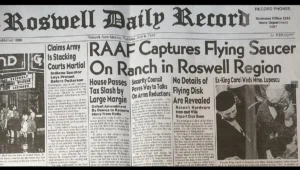
During The Early Nuclear Age & Blue Book Era (1947–1969), the press served as the primary public record for civilian and military encounters. The modern narrative was ignited by the press with the famous July 8, 1947, Roswell Daily Record headline announcing the military’s capture of a “flying saucer.” Just five years later, the 1952 Washington D.C. radar-visual flap forced the Pentagon to hold its largest press conference since World War II to address the objects swarming the capital’s restricted airspace. Archiving these original newspaper clippings and broadcast transcripts provides crucial context for how sightings were treated before official ridicule became systemic policy.
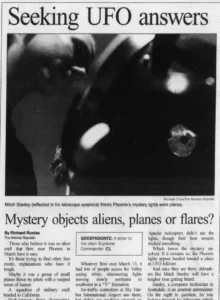
Throughout The Post-Condon & Stigma Era (1970–1999), investigative exposés and leaks became the lifeline of UAP transparency. When thousands of citizens witnessed a massive, silent craft over Arizona on March 13, 1997, it was sustained local news coverage of the Phoenix Lights that ultimately forced the military to respond—even if those explanations were heavily scrutinized. This archive catalogs the vital paper trail of declassified memos, FOIA releases, and legacy reporting that held institutions accountable when official channels denied the phenomenon’s reality.
Journalism has also been instrumental in validating the physical reality of UAPs and pushing for rigorous study. The transition into The Modern Disclosure Era (2017–Present) was directly catalyzed by investigative reporting. The December 2017 New York Times publication of “Glowing Auras and ‘Black Money’” exposed the Pentagon’s secretive AATIP program and brought forward the unclassified Navy targeting videos. This specific reporting shifted the global conversation overnight from fringe speculation to serious scientific, legislative, and military inquiry.
By centralizing these legacy articles, government documents, and foundational media reports, this hub provides researchers, academics, and the public with the verifiable data necessary to connect historical patterns to today’s rapidly evolving intelligence landscape.
We break the history of UAP into the following eras for your search conveneince.
Here we differentiate The types of activities covered in these historic news articles so you may more easliy find items of interest.
Do you know of an interesting and important research paper or other UAP related material, fill out the form below and we’ll review your material for potential inclusion into our database.

This July 2020 New York Times article revealed the continued existence of a dedicated UAP investigative body within the military following the dissolution of AATIP.


This article is one of several out of the Phoenix, AZ reporting on the now famous Phoenix Lights incident of March 13, 2017.

Kean and Blumenthal, who broke the now famous 2017 New York Times article, Glowing Auras and ‘Black Money’, return with another historically important article, breaking the story of whistleblower David Grusch.