
Home » Policy and Governance » Classification Systems
UAP & SETI Frameworks: Classifications, Protocols, and Equations
Describing and Categorizing the UAP Characteristics and Behavior
The scientific study of Unidentified Anomalous Phenomena (UAP) and the Search for Extraterrestrial Intelligence (SETI) both rely on rigorous methodological frameworks to categorize, analyze, and respond to anomalous data. For decades, researchers, government agencies, and academic institutions have developed structured models to bring objective measurement to the unknown. This archive serves as a repository of those tools, cataloging the systems used to quantify, classify, and manage anomalous encounters.
As the conversation around UAP and non-human intelligence shifts from public speculation to serious scientific and legislative scrutiny, standardized reporting and analysis become critical. To help navigate this complex landscape, this hub organizes historical and modern frameworks across three distinct methodologies: Classification Systems, Equations, and Protocols.
Classification Systems
Proper taxonomy is the bedrock of scientific inquiry. Within this archive, you will find detailed documentation on
Classification System – UAP, ranging from J. Allen Hynek’s original Close Encounter scale and Jacques Vallée’s advanced matrices to the modern observational typologies utilized by military and government task forces. Parallel to these are:
Classification System – SETI, which details the specific scales used by radio astronomers and astrophysicists to measure the potential significance of anomalous technological signatures.
Equations
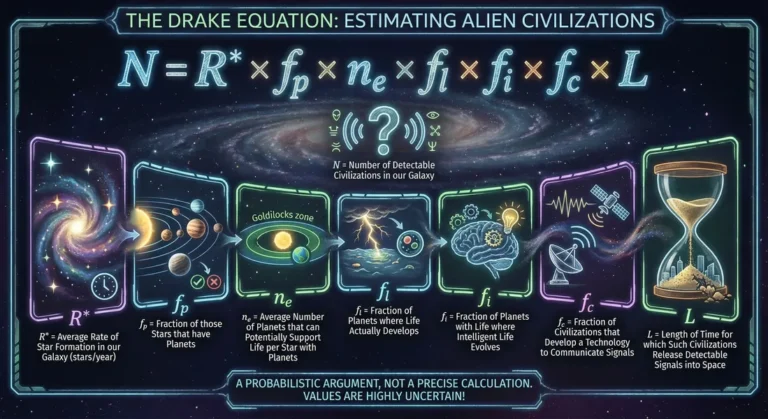
Theoretical mathematics play a crucial role in predicting and analyzing anomalies. Under Equations – SETI, this database explores probabilistic frameworks like the Drake Equation, which attempt to quantify the likelihood of communicative intelligence in the cosmos.
In the emerging field of Equations – UAP, we will document the mathematical models, kinematic formulas, and physical constraints used by researchers to measure anomalous flight characteristics and calculate observables that defy known aerodynamics.
Protocols
Establishing predefined guidelines for data collection and public response ensures scientific integrity and security. The Protocols – SETI section outlines the established international guidelines for verifying, confirming, and announcing the detection of extraterrestrial signals. Similarly, the Protocols – UAP category covers military reporting procedures, aviation safety guidelines, and proposed post-disclosure frameworks designed to manage the societal and scientific impact of unprecedented discoveries.
By filtering through these specific taxonomies, researchers can directly compare the historical methodologies of SETI with the evolving analytical models applied to UAP studies today. Explore the archive below to dive into the specific systems shaping the future of anomalous research.
Browse Frameworks by Type
Our Complete List of Classification Systems
Click on images below for more information on specific activities
Database Last Updated:
September 18, 2026Government Activity FAQ
How are modern Unidentified Anomalous Phenomena (UAP) sightings classified?
Modern UAP sighting classification relies heavily on domain-specific frameworks utilized by government bodies like the Department of Defense’s All-domain Anomaly Resolution Office (AARO). These systems categorize anomalies based on their operating environment—such as aerospace, transmedium, or undersea—and evaluate them against known flight characteristics, standard drone configurations, and foreign adversarial technology.
What is the difference between SETI technosignatures and UAP observables?
SETI technosignatures refer to distant, astronomical evidence of advanced technology—such as narrow-band radio signals, laser emissions, or megastructures detected light-years away using telescopes. UAP observables refer to localized, physical phenomena exhibiting anomalous flight dynamics within Earth’s atmosphere or oceans, measured directly by military and commercial sensor networks.
Are there scientific equations used to analyze UAP flight characteristics?
Yes. While SETI relies on probabilistic equations, UAP researchers apply standard kinematic and aerodynamic physics equations to sensor data (like radar and FLIR) to analyze UAP flight characteristics. By calculating variables such as instantaneous acceleration, G-force tolerance, and estimated mass, scientists can determine if a tracked object demonstrates the “Five Observables” of anomalous aerospace behavior.
What is the official SETI protocol if an extraterrestrial signal is detected?
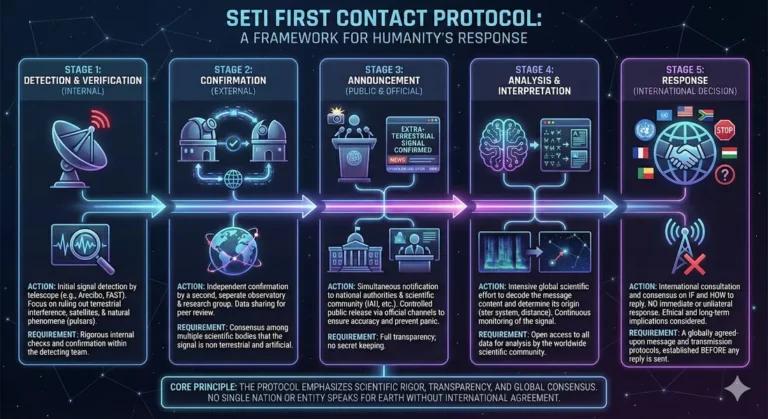
The official SETI first contact protocol, established by the International Academy of Astronautics (IAA), dictates that any potential alien technosignature must be rigorously verified by independent observatories before public disclosure. Crucially, the post-detection guidelines state that no researcher or government should transmit a reply to the source without first achieving a broad international consensus through bodies like the United Nations.
What is the Hynek Classification System for UFO encounters?
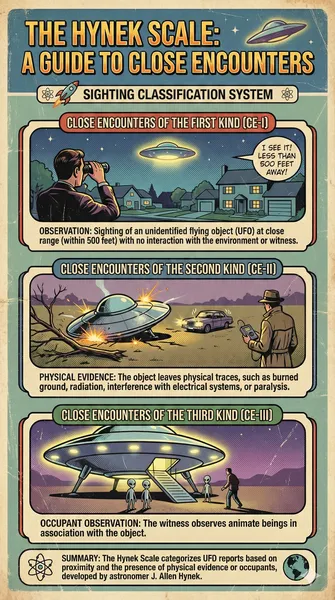
Developed by astronomer J. Allen Hynek during Project Blue Book, the Hynek Classification System categorizes UFO reports into distinct evidentiary tiers based on proximity and interaction. The system introduced the concepts of Daylight Discs, Nocturnal Lights, and the famous “Close Encounters” scale, ranging from the First Kind (a visual sighting within 500 feet) to the Third Kind (the observation of animate beings).
How do scientists measure the significance of alien life discoveries?
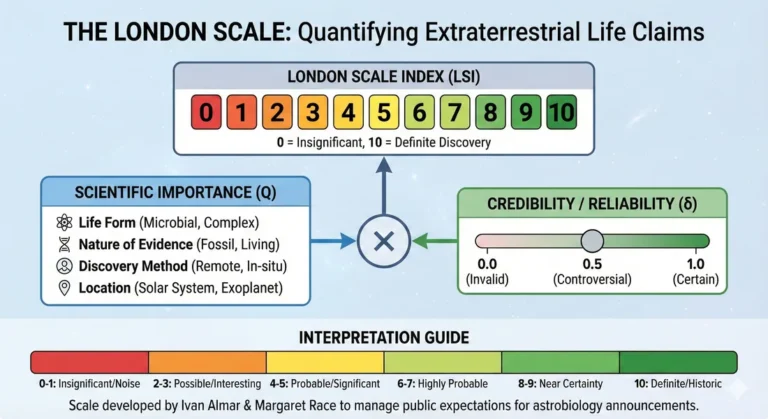
Astrobiologists and astronomers use specialized indices to quantify the impact and credibility of extraterrestrial discoveries. The Rio Scale is used specifically to score the significance of radio signals or technosignatures detected by SETI programs, while the London Scale was created to evaluate the validity and scientific importance of discovering non-intelligent, microbial, or fossilized alien life.
More Detailed UAP Information
Additions Welcome
If you have published (or found online) meaningful UAP material that you feel belongs in our database, please submit it via the form below. We’ll review your submission and consider it for inclusion in our repository.