Home » UAP Reference Library » UAP Book Reviews » High Strangeness & Advanced Theories » The Edge of Reality
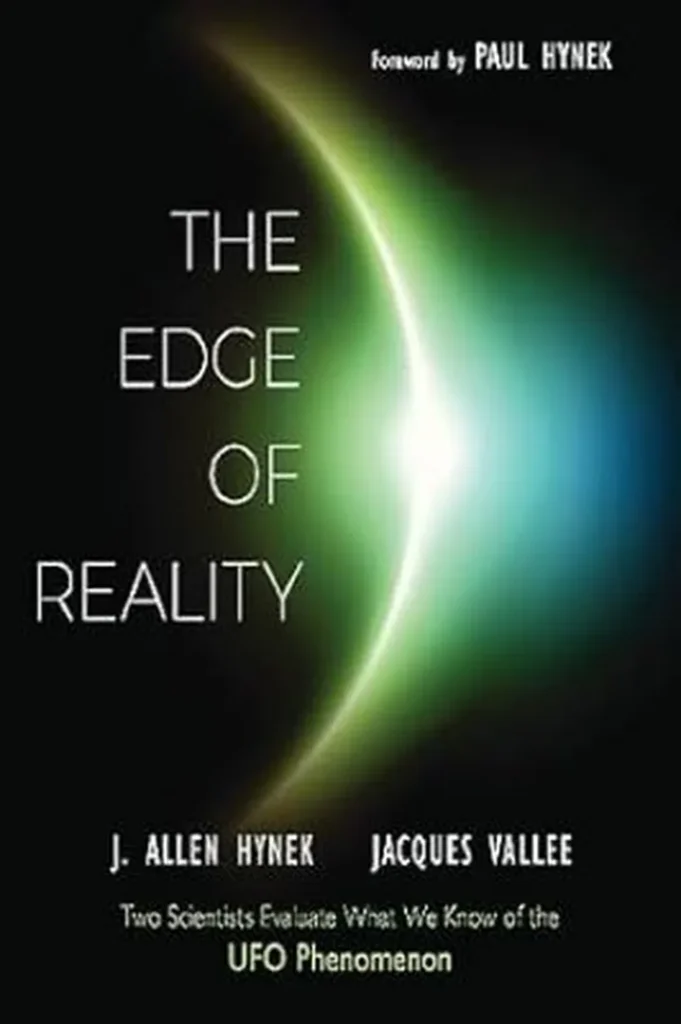
The Edge of Reality
Our Rating:
Author:
Subject Matter Classification:
The Premise
In The Edge of Reality, astrophysicist J. Allen Hynek and computer scientist Jacques Vallée suggest that the UFO phenomenon represents a genuine, scientifically significant anomaly that fundamentally challenges contemporary physical models. Their central thesis is a deliberate pivot away from the Extraterrestrial Hypothesis (ETH)—the assumption that these anomalies are strictly “nuts and bolts” spacecraft from other planets.
Instead, Hynek and Vallée argue that the phenomenon exhibits “high strangeness.” They point to absurd behavioral characteristics, deliberate theatricality, and localized physical and psychological effects that suggest a much more complex, perhaps non-local origin. They hypothesize that the phenomenon may be interdimensional, paraphysical, or operate as a sophisticated “control system” interacting with human consciousness. Ultimately, they argue that the scientific community must abandon its reliance on classical mechanics alone and adopt a multi-disciplinary approach capable of evaluating both hard physical trace evidence and subjective sociological effects.
Why's It's Important
The Edge of Reality is a watershed publication because it marks the intellectual maturation of ufology. Prior to its publication in 1975, serious UAP research was almost exclusively confined to proving the existence of extraterrestrial, interplanetary spacecraft. This text publicly fractured that consensus. By validating “high strangeness” and introducing paraphysical or interdimensional models, Hynek and Vallée permanently expanded the aperture of UAP research. The book laid the theoretical foundation for the modern understanding that the phenomenon is not merely an aerospace or defense problem, but a deeply complex intersection of physics, consciousness, and reality itself.
Our Evaluation
The immediate question is whether a nearly 50 year old book is worth your time. It’s certainly possible. Vallee’s Passport to Magonia and The Invisible College were both written in the 1970s and remain important reading on the path to understanding the UAP phenomenon. The Edge of Reality is an enlightening entrant from the same era.
The book takes the form of conversations between Hynek and Vallée, occasionally facilitated by Dr. Author Hastings, a psychologist and mutual friend. The conversations are sometimes prefaced by a description of a particular UFO case that serves as the basis for the conversation.
One of the best values that the book brings for me is insight into Hynek and his activities. Hynek is less well published than Vallée, so commentary directly from him was educational, including:
– The first-person account of his Project Blue Book years and his evolution in thinking on the UAP topic.
– His understanding of how Project Blue Book was managed inside the Air Force: A low priority, amateurly run project, of interest to few within the Air Force. “Sloppy, just kid stuff.”
– His recounting of the famous “swamp gas” incident of 1966, how it was handled and how the whole notion of swamp gas became involved in the case. This is the moment, according to Hynek, when he finally decided he had had enough of Project Blue Book.
Another point that jumps out after reading the book during the current era, is that progress on this topic is wholly dependent then and now on engaging the scientific community. Again and again, Hynek and Vallée speak on the need for one or several scientists to speak up in order to progress. They talk about the continual discrediting of the topic keeping the scientific community away. They conclude that engagement by the scientific community is the way forward.
Any student or researcher into of the phenomenon owes it to themselves to be well steeped in the thinking of both Vallée and Hynek. This book offers insights from both men.
The Verdict