The Foundation of Modern UAP Data: Legacy UFO Researchers and Organizations
You can find all of our Government UAP Data Repositories Records at our UAP Data Repositories Hub.
Long before modern congressional hearings and declassified military videos, the empirical foundation of UAP studies was built by civilian organizations and independent scientists. During the mid-20th century, official government programs like Project Blue Book often prioritized public relations and the dismissal of anomalous encounters over rigorous scientific inquiry. In response, early UFO researchers and civilian organizations stepped in to fill the investigative void.
Pioneers such as Dr. J. Allen Hynek, Dr. James E. McDonald, and Major Donald Keyhoe recognized the need for data collection and reporting in the absence of publicly available governmental action. By establishing organizations like the National Investigations Committee on Aerial Phenomena (NICAP), the Aerial Phenomena Research Organization (APRO), and later the Center for UFO Studies (CUFOS), they created the first standardized methodologies for cataloging civilian encounters, radar-visual sightings, and physical trace evidence.
These legacy organizations operated as the world’s de facto UAP data repositories. They built extensive archives of raw witness testimonies, field investigation reports, and historical press clippings that would have otherwise been lost or discarded. Their meticulous record-keeping demonstrated that the UAP phenomenon was not a series of isolated anecdotes, but a global, persistent issue with measurable patterns.
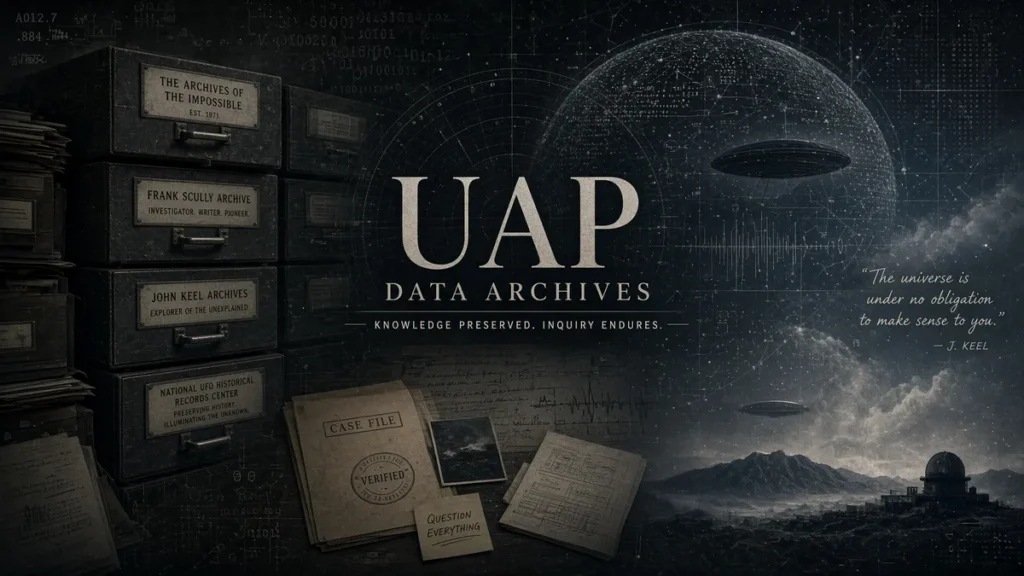
Today, the files compiled by these early investigators remain vital primary source material. Modern researchers, aerospace engineers, and data scientists continually mine these historical archives to identify geospatial trends, cross-reference legacy cases, and establish a historical baseline for anomalous activity. The UAP Data Archives hub exists to ensure that the decades of foundational data collected by these civilian pioneers are easily discoverable and fully accessible to the modern research community.
About Our UAP Data Archives Taxonomies
To understand and navigate these archives we offer two taxonomies:
Archive Origins
The type of organization holding these materials.
Archive Scope
The type of materials held in the archive. Multiple categories may be assigned to each archive.
Submit your UAP Material
Do you know of an interesting and important research paper or other UAP related material, fill out the form below and we’ll review your material for potential inclusion into our database.