Home » Policy and Governance » Classification Systems » SETI First Contact Protocol
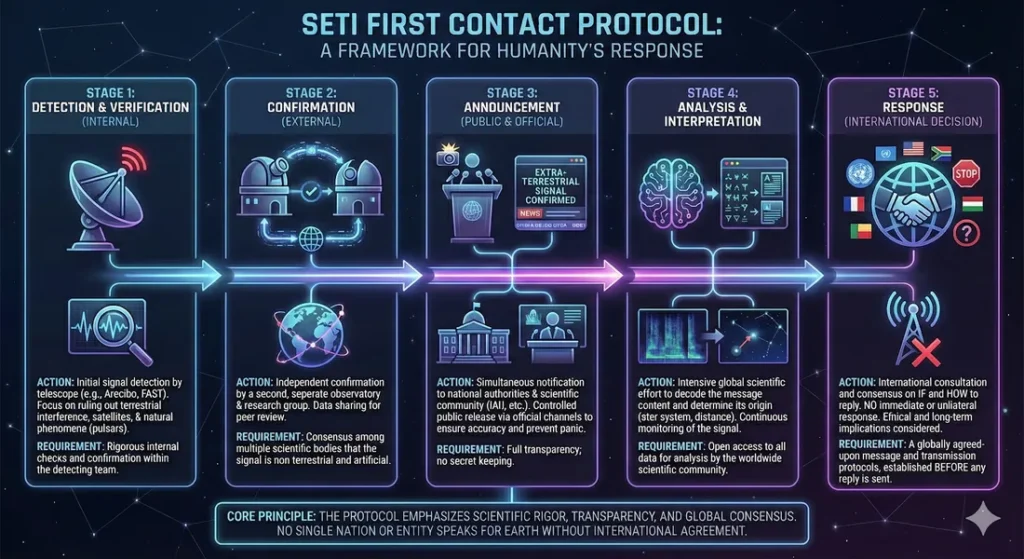
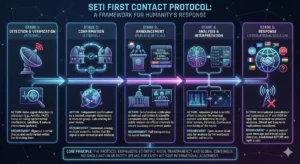
The SETI First Contact Protocol, formally known as the “Declaration of Principles Concerning Activities Following the Detection of Extraterrestrial Intelligence,” is a set of guidelines designed to govern the scientific community’s response to the discovery of an alien signal. It establishes a clear order of operations to prevent false alarms and manage the global impact of such a profound revelation. The protocol dictates that any putative detection must be rigorously authenticated by independent observatories before any public announcement is made.
Once a signal is verified, the discoverer is tasked with notifying international authorities—such as the UN Secretary-General—as well as relevant astronomical organizations. The guidelines strictly prohibit researchers from transmitting a reply to the source of the signal without first achieving a broad international consensus. Additionally, all data bearing on the evidence of extraterrestrial intelligence must be permanently recorded and made accessible to the broader scientific community for ongoing analysis.
The original protocols were drafted in 1989 by the SETI Committee of the International Academy of Astronautics (IAA) and were subsequently endorsed by major organizations like the International Institute of Space Law. At the time, the guidelines were shaped around the methodical pace of traditional radio astronomy and a pre-internet media landscape. The underlying assumption was that scientists would have ample time to quietly cross-verify a signal over weeks or months before the public caught wind of the discovery.
In recent years, the scientific community recognized that the 1989 framework was poorly equipped for the modern era of social media, rapid information leaks, and advanced citizen science. Acknowledging that keeping a potential signal secret for months is virtually impossible today, the IAA and the SETI Permanent Committee have actively worked to draft updated protocols. These modernized drafts focus on managing the inevitable flow of real-time, unverified information and expand the scope of detection beyond radio waves to include a wider range of technosignatures across the electromagnetic spectrum.