The History and Nature of Government UAP Activity
You can find all of our UAP and SETI Classification System Records at our UAP Classification System Hub.
The advancement of Unidentified Anomalous Phenomena (UAP) and Search for Extraterrestrial Intelligence (SETI) research relies entirely on the transition from anecdotal observation to empirical science. At the frontier of human knowledge, data is often fragmentary, unpredictable, and highly unusual. Without standardized frameworks, this information remains chaotic and isolated. Classification systems, protocols, and equations are the foundational tools that allow researchers, scientists, and government bodies to establish a common analytical language.
These frameworks transform subjective sightings and faint radio signals into measurable, comparative data. Equations provide the mathematical rigor needed to evaluate cosmic probabilities and physical kinematics. Classification systems create structured taxonomies to organize diverse anomalies into recognizable patterns, allowing researchers to separate mundane events from genuine anomalies. Protocols dictate the strict rules of engagement, data collection, and public disclosure, ensuring that potentially paradigm-shifting discoveries are handled with scientific integrity, transparency, and global coordination.
About Our Classification Systems Taxonomies
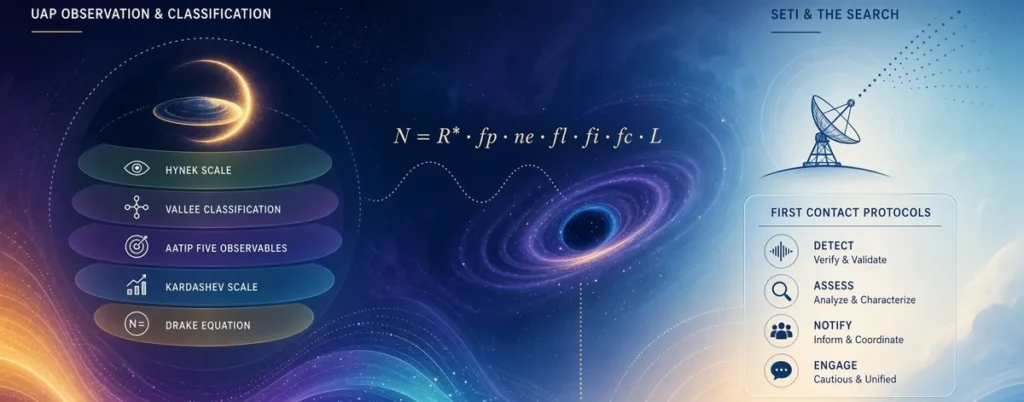
To properly map the classification landscape, this research hub categorizes these frameworks into a single taxonomy of six distinct areas of study:
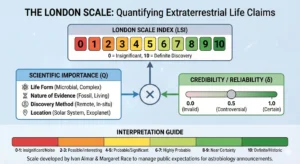
Analytical frameworks, such as the Rio and London Scales, used by astrobiologists and astronomers to quantify the scientific importance, credibility, and potential societal impact of extraterrestrial discoveries.
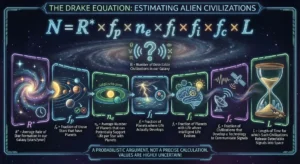
Mathematical models—most notably the Drake Equation—designed to calculate the probabilistic variables required for intelligent life, habitable worlds, and communicative civilizations to exist in the cosmos.
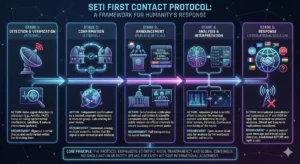
Internationally recognized guidelines and post-detection procedures that govern how the scientific community must rigorously verify, share, and publicly announce the discovery of an alien technosignature.
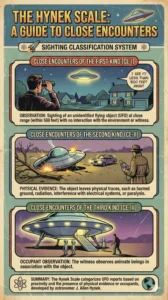
Taxonomies used to categorize anomalous phenomena based on physical appearance, interaction levels, or operating environments, ranging from the historic Hynek Close Encounter Scale to modern defense intelligence designations.
Applied physics and kinematic formulas utilized by analysts to extract hard metrics from military sensors, calculating the extreme velocity, G-force tolerance, and acceleration of anomalous aerospace objects.
Formal government reporting mechanisms, military data collection standards, and investigative procedures designed to secure and systematically analyze UAP encounters while protecting sensitive intelligence-gathering methods.
Submit your UAP Material
Do you know of an interesting and important research paper or other UAP related material, fill out the form below and we’ll review your material for potential inclusion into our database.