Home » Research Database » Data Archives » Personal Papers and Manuscripts » Betty and Barney Hill Papers
Betty and Barney Hill Papers
Archive Name
Betty and Barney Hill Papers
Archive Location
18 Library Way, Durham, NH 03824, USA
Conditions of Access
The collection is open to the public for in-person research in the Dimond Library Reading Room (Room 101) by appointment via archives@unh.edu
Contains Archives of:
Betty Hill, Barney Hill
Era Covered
1961/2006
Material Physical Size
2.33 cubic feet housed across 7 boxes
Description
Official Title / Name
Betty and Barney Hill Papers (Collection Identifier: MC 197)
Stewarded by: Milne Special Collections and Archives, University of New Hampshire Library
Physical Location
Milne Special Collections and Archives
Room 101 (Level 1), Ezekiel W. Dimond Library
University of New Hampshire
18 Library Way, Durham, NH 03824, USA
Phone: (603) 862-1535 / (603) 862-2714 | Email: archives@unh.edu
Conditions of Access
-
Public Access: The collection is open to the public for in-person research in the Dimond Library Reading Room (Room 101) by appointment via
archives@unh.edu. -
Separated / Restricted Material: One folder of correspondence to and from “D.R.” was removed from public access at the request of the donor (Kathleen Marden) and is held separately in department files.
-
Copyright, Reproduction & Licensing: Materials are governed by U.S. copyright law. Standard research reproduction inquiries go to Special Collections (
images@unh.eduorarchives@unh.edu). Commercial licensing and reproduction of items from the collection are managed separately by UNHInnovation (unh.innovation@unh.edu, (603) 862-4125).
Years Covered
1961–2006 (covering the September 1961 encounter, four decades of Betty Hill’s subsequent UAP correspondence and research, and posthumous materials up to the November 2006 donation).
Physical Size
2.33 cubic feet housed across 7 boxes (including standard manuscript folders and oversized/artifact storage boxes).
Description of the Archival Creators & Stewarding Institution
The archival value of this collection rests on a two-stage preservation effort: grassroots documentation by Betty Hill and institutional stewardship by the University of New Hampshire Library.
-
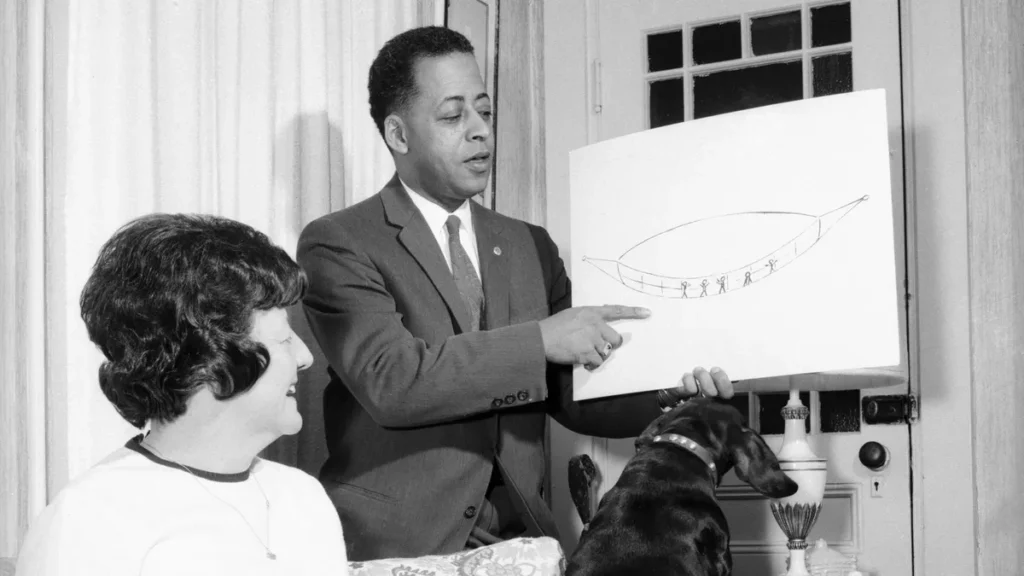
Betty and Barney Hill (Creators): Betty (Eunice) Hill (1919–2004), a UNH alumna and social worker, and Barney Hill (1923–1969), a U.S. postal worker and civil rights leader, were Portsmouth, New Hampshire residents active in the NAACP and the local U.S. Civil Rights Commission. Following their September 19, 1961 White Mountains encounter—widely regarded as the first thoroughly documented modern UAP abduction case—Betty Hill spent the remaining four decades of her life acting as a dedicated grassroots archivist of the case and of the broader UAP field. Rather than discarding materials after media attention faded, she systematically retained physical artifacts, personal journals, legal contracts, star-map correspondence, and decades of letters exchanged with researchers, journalists, and fellow experiencers.
-
Milne Special Collections and Archives (Steward): The University of New Hampshire’s primary archival repository maintains roughly 18,000 linear feet of rare books, manuscripts, university records, and audiovisual collections. When Betty Hill’s niece, Kathleen Marden, donated the collection on November 28, 2006 (Accession 2007.01), UNH took the unusual step for a major public research university of formally accessioning, preserving, and cataloging a landmark UAP close-encounter archive. Processed by archivist Roland Goodbody in 2009 (with a DACS-compliant finding aid revised in 2018), UNH’s stewardship ensures that primary evidence from a foundational UAP case remains accessible to historians, sociologists, and UAP researchers rather than vanishing into private hands.
Description of the Archive
The Betty and Barney Hill Papers (MC 197) document both the 1961 encounter and the resulting 45-year paper trail of investigations, public correspondence, and cultural impact, alongside a smaller body of records covering the Hills’ civil rights work. All materials are in English and are organized into 11 archival series:
-
Correspondence (letters exchanged with researchers, investigators, media, and the public, including material relating to the star map and John G. Fuller)
-
Personal History (biographical records, genealogy, and materials on Betty and Barney’s marriage)
-
Notebooks and Journals (Betty Hill’s personal notes, reflections, and essays)
-
Manuscripts (draft writings and case documentation)
-
Contracts and Agreements (publishing and media agreements)
-
Subject Files (topical UAP research files compiled by Betty Hill)
-
Publications (books, magazines, and printed UAP materials)
-
Newsclippings (contemporaneous press coverage of the case and UAP history)
-
Photographs (prints and slides related to the Hills and UAP topics)
-
DVDs (audiovisual recordings related to the case and media appearances)
-
Artifacts and Oversized Materials
Notable Holdings:
-
Physical Artifacts: The torn and stained blue dress Betty Hill wore on the night of September 19, 1961, and “Junior,” a ceramic bust of an alien sculpted to match Betty’s description.
-
Visual & Case Documentation: 1967 artworks by David G. Baker depicting the encounter, correspondence concerning the Zeta Reticuli star map, and materials tied to author John G. Fuller (The Interrupted Journey).
-
Civil Rights Records: Barney Hill’s NAACP correspondence, a scrapbook of his NAACP activities, speech notes from the Portsmouth Naval Shipyard, and NAACP Life Membership plaques for both Betty and Barney.
For UAP research, MC 197 is a rare benchmark: a primary-source close-encounter archive housed in an accredited academic special collections vault with standardized bibliographic citations, allowing independent verification of primary documents without relying solely on secondary retellings.
Additional Links
-
Organization Home Page: UNH Milne Special Collections & University Archives
-
Archival Material (Official Finding Aid): Betty and Barney Hill Papers (MC 197) – UNH ArchivesSpace
-
Archival Access & Usage Guide: Using the Betty & Barney Hill Collection – UNH Library
-
External References:
More UAP Data Repositories of this type