Where to Start?
UFO / UAP is a fascinating topic. It has growing acceptance in the media, and you’re interested. But where to start? How does one get their hands around the complex topic of UAP. Let’s start by differentiating between the terms UFO and UAP. We’ll then discuss the name change from UFO to UAP. Finally, we’ll provide you with a resource guide to help you educate yourself on the topic.
The Difference Between UFO and UAP
UFO (Unidentified Flying Object)
This term was coined by the U.S. Air Force in the early 1950, during Project Blue Book. It was originally intended to serve as a neutral, clinical replacement for sensationalized phrases like “flying saucers” and “foo fighters.” Technically, a UFO is any airborne object that cannot be immediately identified by the observer.
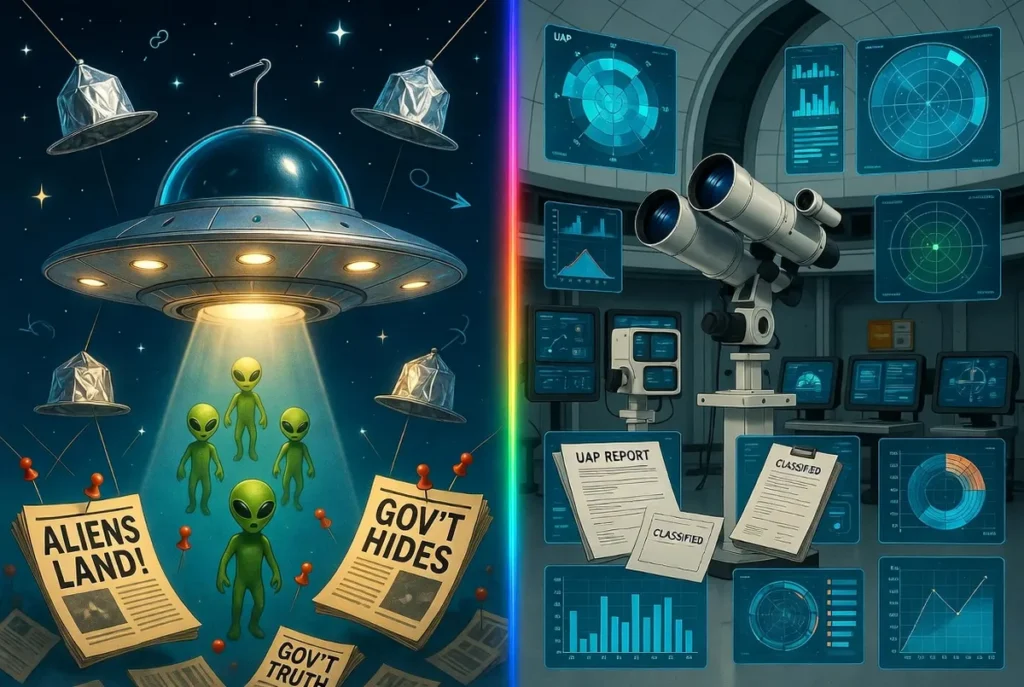
Over the past seven decades, pop culture has hijacked the term. Today, “UFO” carries tremendous cultural baggage, frequently conjuring up sci-fi type images rather than objective, scientific observation.
UAP (Unidentified Anomalous Phenomena)
Originally introduced in the modern era as “Unidentified Aerial Phenomena,” the term was officially broadened by the U.S. DoW to “Unidentified Anomalous Phenomena.” A UAP refers to objects, events, or lights observed in the air, in space, underwater, or traveling seamlessly between these domains (transmedium travel) that cannot be readily explained by known technology or natural occurrences.
Why the Name Change - UFO vs. UAP
Focusing the narrative on the term UAP helps to achieve the following:
It Reduces Stigma: Using “UAP” frames the conversation exactly where it belongs today: around national security, aviation safety, and scientific inquiry. It encourages whistleblowers and active-duty personnel to treat the topic seriously.
It Expands the Scope: The word “Anomalous” is far more accurate than “Flying.” Contemporary reports show these objects don’t just fly; they operate in orbit and have been tracked plunging into the oceans without splashing or loss of speed.
It Aligns with Official Disclosure: If you want to track congressional hearings, read modern legislation, follow the reporting of advocacy groups, or understand current polling data on public sentiment, “UAP” is the legal and institutional language being used. To follow the official paper trail of disclosure, you will want to use this search term.
Beginners Resource Guide
At the UAP News Center, we canvas the media for news and information daily. This allows us to stay abreast of all of the news and research resource savailable in the UFO / UAP ecosystem. Here are a few resources that we feel are useful persons new to the topic
Websites
- UAP Guide – A 15-minute introduction to unidentified anomalous phenomena (UAP)
- UAP Evidence
- What are UFOs? UAPs? – an infographic breaking down various theories behind UAP
- Aliens Info
Books
I generally recommend these three books as entry points into the phenomenon:
-
Interstellar: The Search for Extraterrestrial Life and out Future in the Stars – A highly credible scientist makes the argument for seeking an understanding of the UAP phenomenon.
-
UFOs: Generals, Pilots and Government Officials Go On the Record – Investigative Reporter Leslie Kean’s New York Times best seller takes pains to document a handful of well researched UAP sightings.
-
Imminent: Inside the Pentagon Hunt for UFOS – A former Senior Intelligence Officer, author Luis Elizondo gives a compelling overview of the various aspects of the UFO topic.