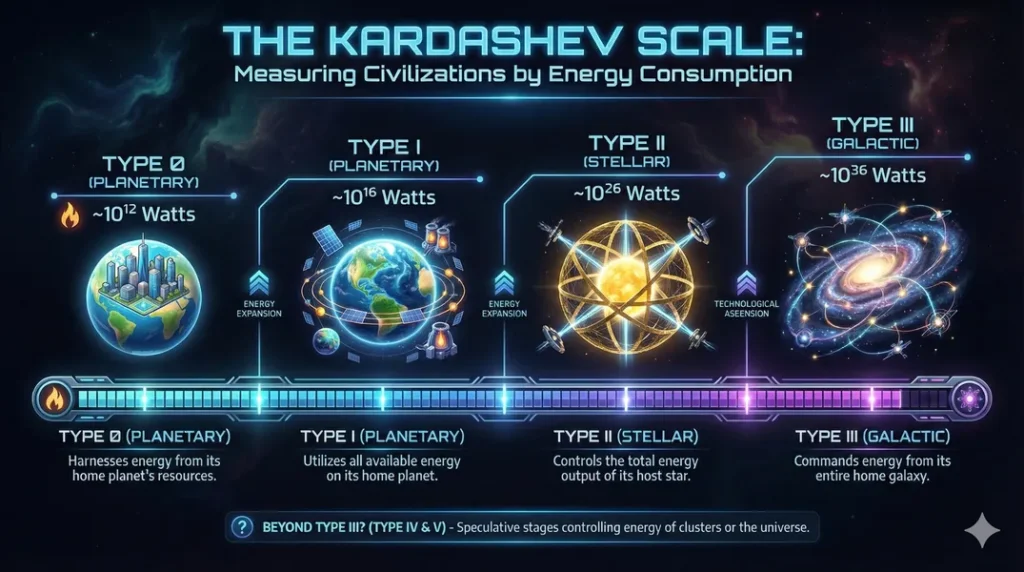
The scale categorizes hypothetical civilizations into three primary tiers based on their energy consumption:
Type I (Planetary): A civilization capable of utilizing all the available energy on its home planet, as well as the total energy reaching it from its parent star (roughly $10^{16}$ watts).
Type II (Stellar): A civilization capable of harnessing the entire energy output of its host star (roughly $10^{26}$ watts). This is typically visualized through hypothetical megastructures like a Dyson Sphere, which would completely enclose a star to capture its radiation.
Type III (Galactic): A civilization capable of controlling and utilizing the energy resources of an entire galaxy (roughly $10^{36}$ watts).
The primary value of the scale lies in its application to the Search for Extraterrestrial Intelligence (SETI). By quantifying the energy usage of advanced civilizations, the scale gives astronomers concrete techno-signatures to look for in deep space. For instance, if a Type II or Type III civilization exists, their massive energy consumption and potential megastructures would alter the light spectrum of stars or produce specific infrared emissions that we could detect. It provides a practical, physics-based roadmap for classifying potential alien life, while also serving as a benchmark for humanity’s own technological trajectory.
The scale was developed by Soviet astrophysicist Nikolai Kardashev and proposed in a 1964 paper titled “Transmission of Information by Extraterrestrial Civilizations”. Kardashev was initially calculating the required power for a light or radio signal to be transmitted across the universe so that radio scientists on Earth could detect it. This calculation became the baseline energy cutoffs for his Type II and Type III categories.
In 1973, American astronomer Carl Sagan modified the scale to allow for finer, decimal-based gradations. Using Sagan’s formula, which factors in both renewable and nonrenewable energy, humanity is currently estimated to be around a Type 0.73 civilization. Since its inception, other scientists like John D. Barrow and Michio Kaku have proposed extensions to the scale (such as Types IV and V, or focusing on micro-dimensional mastery).
Special thanks go to our friends at New Space Economy for providing the Infographic.