Home » Policy and Governance » Classification Systems » Interstellar Object Significance Scale (Loeb Scale)
Interstellar Object Significance Scale (Loeb Scale)
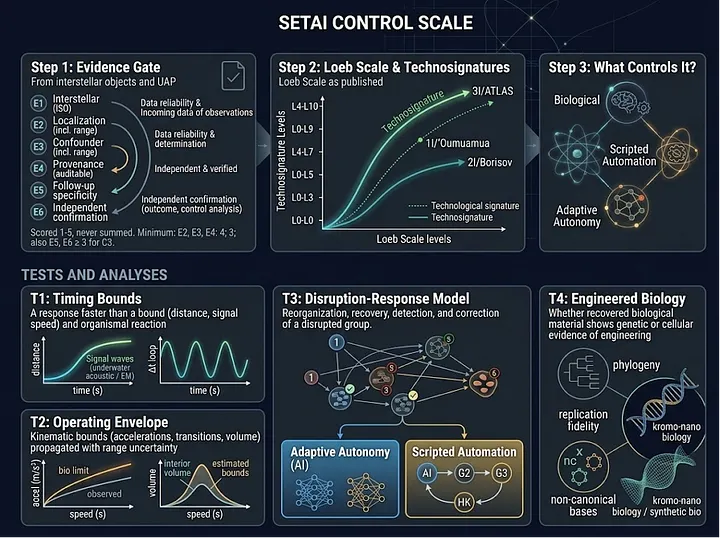
What it Does
a classification framework used by astronomers to assess incoming interstellar objects (ISOs) based on their anomalous characteristics and potential as technological artifacts.
Description
What the Scale Describes
The scale extends the framework of the Torino Scale but applies it specifically to objects originating from outside our solar system. It assigns a score from 0 to 10 based on observed anomalies across domains like trajectory, non-gravitational acceleration, spectroscopic signatures, and morphology:
-
Levels 0 to 3 (Green/Yellow Zones): Represent objects consistent with natural phenomena (like comets and asteroids), allowing for minor unexplained variations or single anomalies (such as slight trajectory deviations).
-
Levels 4 to 7: The critical threshold where technosignature indicators enter formal consideration. Objects here exhibit multiple persistent anomalies (e.g., extreme non-gravitational acceleration without outgassing, highly unusual albedo, or directed emissions) that hint at an artificial origin. These levels trigger immediate, enhanced observational campaigns and potential UN notifications.
-
Levels 8 to 10 (Red Zone): Reserved for confirmed artificial technology, with Level 10 indicating alien technology that poses a direct threat of catastrophic collision or interaction with humanity.
The Value of the Loeb Scale
The primary value of the Loeb Scale is that it prepares the astronomical community for an era of routine ISO encounters. With facilities like the Vera C. Rubin Observatory expected to dramatically increase the detection rate of ISOs, scientists need a standardized protocol. Previous risk scales assumed all incoming objects were natural. The Loeb Scale explicitly bridges the gap between planetary defense and SETI by providing a quantitative framework to evaluate whether a fast-moving object might be a piece of extraterrestrial technology, ensuring that future anomalies trigger rapid observation before they leave the solar system.
History and Comments
The scale was developed by researchers Omer Eldadi, Gershon Tenenbaum, and Harvard astrophysicist Dr. Abraham (Avi) Loeb. It was first introduced via preprints in August 2025 and formally published in the International Journal of Astrobiology in November 2025. The creators designed it directly in response to the controversy surrounding 1I/’Oumuamua—which Loeb argued could be an artificial lightsail—as well as subsequent ISOs like 2I/Borisov and 3I/ATLAS. In late 2025, a differential version of the scale was also proposed by researchers to allow an object’s score to update dynamically in real-time as it approaches Earth and more observational data is gathered.
More UAP and SETI classifications and protocols of this type