Home » Policy and Governance » Classification Systems » The Vallee Classification System for UAP Encounters
The Vallee Classification System for UAP Encounters
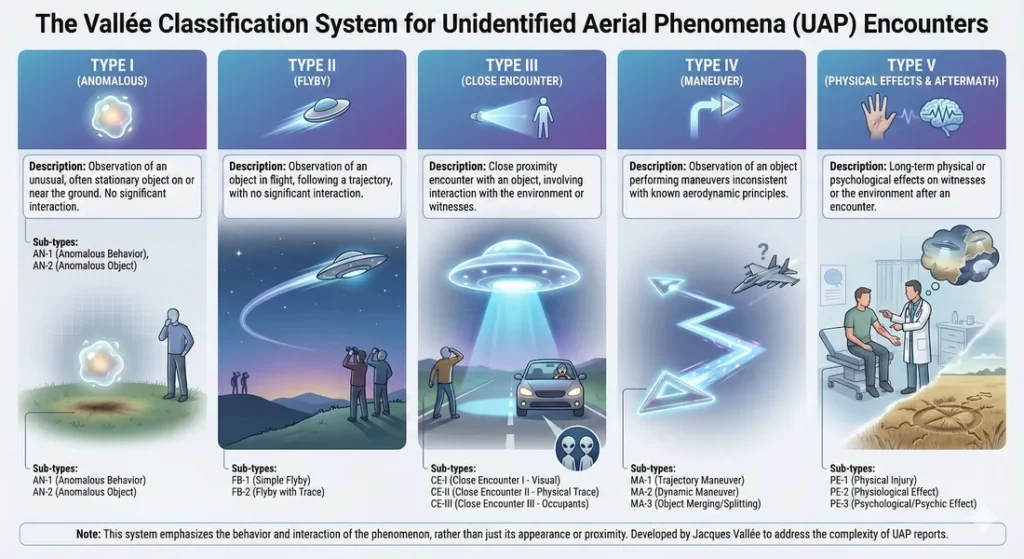
What it Does
The Vallée Classification System is a comprehensive taxonomy used by investigators to categorize Unidentified Anomalous Phenomena (UAP) and associated paranormal events.
Description
What the Scale Describes
The system evaluates a UAP encounter across three distinct tiers to create a highly specific profile of the event:
1. Event Type It categorizes the fundamental nature of the anomaly into four groups:
-
Anomaly (AN): Unexplained phenomena not involving a structured craft (e.g., amorphous lights, unexplained physical traces, or paranormal manifestations).
-
Fly-By (FB): Observation of a UAP in continuous, straight-line flight.
-
Maneuver (MA): A UAP exhibiting a discontinuous trajectory, non-linear motion, or anomalous flight characteristics (e.g., sharp drops, sudden reversals).
-
Close Encounter (CE): An encounter with a UAP at a distance of less than 500 feet.
2. Intensity Rating (1 to 5) Each event type is assigned a number based on its impact on the witness and the environment:
-
1: Simple visual observation with no lasting physical trace.
-
2: The event leaves lasting physical evidence (e.g., radar confirmation, ground traces, electromagnetic interference).
-
3: Entities or occupants are observed in association with the anomaly.
-
4: The witness experiences personal interaction or a transformation in their sense of reality (this includes alien abduction).
-
5: The encounter results in permanent physiological injury or death.(Using this matrix, a standard abduction by beings from a landed craft is a CE4, while a witness suffering radiation burns from a radically moving craft is an MA5).
3. The SVP Credibility Rating: Vallée added a three-digit code to evaluate the scientific rigor of the report:
-
S (Source Reliability): Rated 0 to 4 (from “unknown source” to “first-hand interview by a reliable investigator”).
-
V (Site Visit): Rated 0 to 4 (from “not visited” to “visited by a skilled analyst”).
-
P (Possible Explanations): Rated 0 to 4 (from “easily attributable to natural causes” to “evidence wholly inconsistent with natural causes”).
The Value of the System
The primary value of the Vallée Classification System is its ability to capture the “high strangeness” of UAP events. Earlier systems only measured the physical proximity of an object. Vallée’s matrix allows researchers to quantify behavioral anomalies (how the object moves), physiological and psychological effects on the witness, and the rigorousness of the investigation itself. By including consciousness-altering effects and strict credibility metrics, it treats UAP encounters as complex, multidimensional events rather than just nuts-and-bolts aerospace anomalies.
History and Comments
The system was developed by French astrophysicist, computer scientist, and pioneering UFO researcher Jacques Vallée. Vallée worked closely as a research associate with J. Allen Hynek, who created the original Close Encounter (CE1 to CE3) scale in 1972.
Over time, Vallée realized that Hynek’s scale was insufficient for capturing the bizarre, psychological, and seemingly interdimensional aspects of many encounters he investigated. Vallée formally introduced this expanded classification matrix in his 1990 book, Confrontations: A Scientist’s Search for Alien Contact, effectively superseding Hynek’s model by adding the 4th and 5th intensity tiers and the Anomaly/Maneuver/Fly-By classifications.
Special thanks to our friends at New Space Economy for providing the infographic.
More UAP and SETI classifications and protocols of this type