Home » UAP Reference Library » UAP Book Reviews » Experiencers & First-Hand Accounts » Hunt for the SkinWalker
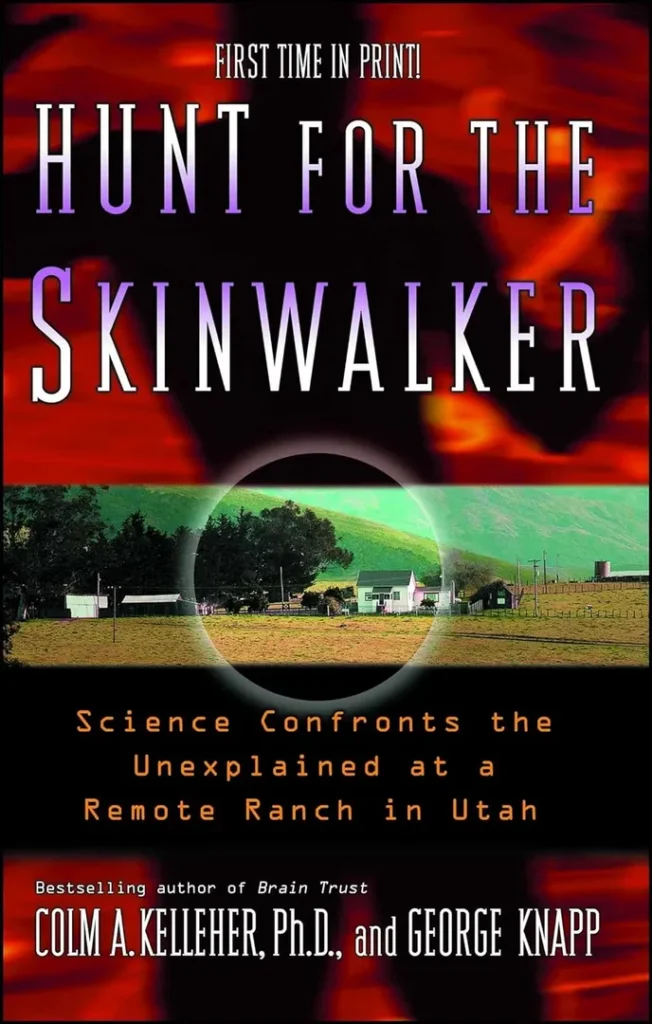
Hunt for the SkinWalker
Our Rating:
Author:
Subject Matter Classification:
The Premise
This book presents a multi-year scientific effort to document and interpret a concentrated cluster of anomalous events reported on the now famous Skinwalker Ranch property in Utah’s Uinta Basin.
The core narrative begins with the experiences of a ranching family from roughly 1994–1996. Reported incidents included repeated cattle mutilations with atypical tissue removal and limited residual blood, large unidentified aerial objects, luminous orbs, and encounters with oversized or atypical animals (including a large wolf-like creature that was reportedly shot without evident effect and left tracks that terminated). Local oral traditions involving “skinwalkers” (shapeshifting entities in certain Southwestern Indigenous accounts) are noted as cultural context for the site’s name, though the book does not treat folklore as explanatory evidence.
In 1996 the property was acquired by Robert Bigelow and placed under the National Institute for Discovery Science (NIDS). Kelleher and a multidisciplinary team installed monitoring equipment, conducted repeated site visits, and logged events over approximately eight years. The book’s central argument is that the observed phenomena form a coherent but non-replicable pattern that resists conventional categorization: aerial objects co-occur with physical effects on livestock, transient biological entities, and instrument anomalies (magnetic, electromagnetic, or optical). The authors advance the hypothesis that the site functions as a localized “window” or interactive zone in which an intelligence (or set of intelligences) can selectively manifest, manipulate the environment, and evade systematic instrumentation—sometimes described as a cat-and-mouse dynamic. They consider, without endorsing as proven, several frameworks drawn from physics and anomalous-phenomena literature: interdimensional transit, advanced technology of unknown origin, and (less favored) purely prosaic or hoax explanations.
Primary evidence consists of:
- First-person accounts from the original ranching family and subsequent NIDS personnel (including Kelleher’s own reported observation of a large humanoid form in a tree in March 1997, followed by recovery of a single deep oval track in snow).
- Veterinary and photographic documentation of animal carcasses.
- Instrument logs and field notes from sensors and cameras deployed on the property.
- Corroborating reports from other visitors and earlier regional sightings.
The authors explicitly note that high-quality, instrumentally captured, publicly releasable data proved elusive; many events occurred outside instrument fields or left only transient traces. They treat this non-reproducibility itself as data relevant to the hypothesized intelligence’s behavior rather than as disconfirmation.
Why's It's Important
The book is analytically significant less for any single decisive measurement than for the institutional and conceptual pathway it created. It is the primary public record of NIDS’s sustained, privately funded attempt to apply scientific instrumentation and personnel to a high-strangeness locale that mixed aerial phenomena with biological and physical effects. That record became the principal reference text for subsequent interest in the site.
In 2007 a Defense Intelligence Agency analyst (James Lacatski) read the book and visited the ranch; the encounter contributed to the formation of the Advanced Aerospace Weapon System Applications Program (AAWSAP), under which Bigelow Aerospace Advanced Space Studies (BAASS) later conducted further ranch-related work as a contractor. The volume therefore functions as a documented link between a private anomalous-phenomena investigation and a U.S. government intelligence program focused on advanced aerospace threats. It also popularized the “hitchhiker effect” (the claim that anomalous activity can accompany investigators off-site) and the notion of a localized, interactive anomalous zone—concepts that later appear in AAWSAP-related reporting and in the 2021 follow-on volume Skinwalkers at the Pentagon.
From a methodological standpoint the book illustrates both the opportunities and limits of applying scientific protocols to high-strangeness reports: multi-year presence, sensor deployment, and multidisciplinary staffing produced a dense case archive but no peer-reviewed, instrumentally confirmed anomalous mechanism. Subsequent official reviews (including AARO historical assessments) have treated the paranormal framing associated with the ranch as a distraction from more constrained UAP datasets, while proponents continue to cite the NIDS period as evidence that certain locales exhibit correlated, non-aerial effects worthy of systematic study. The volume remains the foundational public source for evaluating both the empirical claims and the institutional trajectory that connected a Utah ranch to Pentagon-funded UAP research.
Our Evaluation
This is the fascinating and sometimes disturbing story of a group of government scientists who research the happenings at Skinwalker Ranch. It does an excellent job of describing occurrences that are wildly outside of our perceived reality yet credibly observed and researched by highly intelligent and credentialed individuals. It helps us to understand that the “high strangeness” aspect of the UAP phenomenon is potentially real and worth of further research.
The Verdict(s)