Home » UAP Reference Library » UAP Book Reviews » Experiencers & First-Hand Accounts » The Day After Roswell
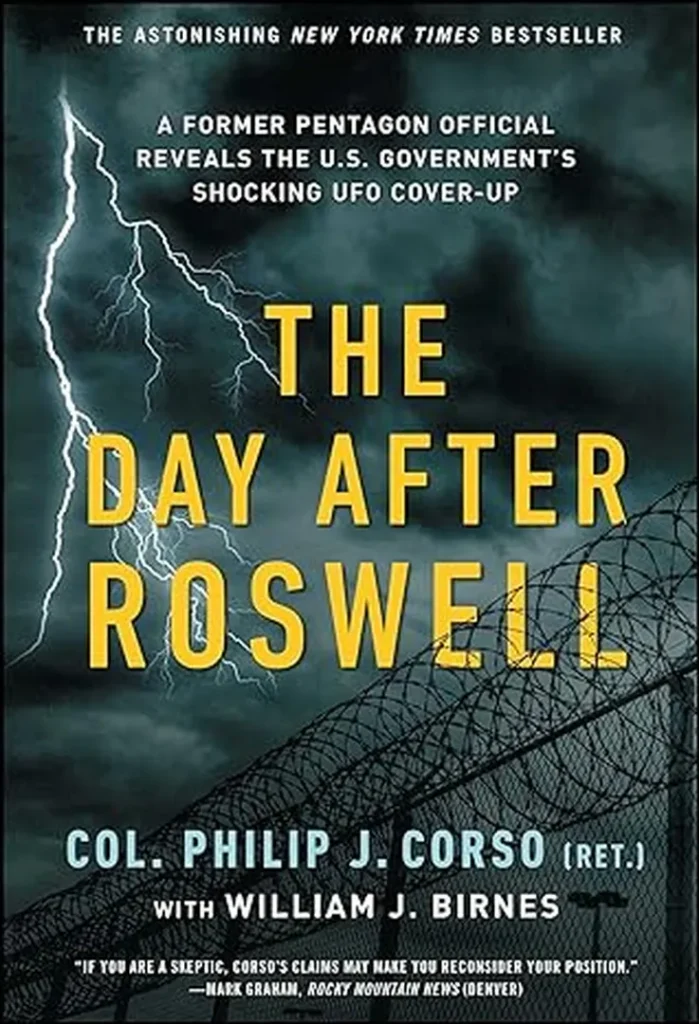
The Day After Roswell
Our Rating:
Subject Matter Classification:
The Premise
In The Day After Roswell, former U.S. Army intelligence officer Philip J. Corso posits that the United States government recovered an extraterrestrial spacecraft and biological entities from Roswell, New Mexico, in 1947. The book’s central thesis is that the military intentionally integrated the recovered alien technology into the American defense and private industry infrastructure.
Corso’s primary arguments include:
-
The Technology Transfer Program: Corso claims that during his tenure in the early 1960s at the Pentagon’s Foreign Technology desk, he was tasked with seeding recovered Roswell artifacts to major defense contractors (such as Bell Labs). He argues that contractors were told they were analyzing recovered Soviet or foreign technology, allowing them to reverse-engineer the materials and file patents without knowing the true origin.
-
Technological Leaps: The book attributes several major mid-century technological breakthroughs directly to this reverse-engineering effort, specifically claiming that integrated circuits, fiber optics, lasers, and super-tenacity fibers (like Kevlar) were derived from the Roswell craft.
-
The Cold War as a Cover: Corso argues that the Cold War arms race and the creation of NASA served a dual purpose. While publicly aimed at deterring Soviet aggression, these massive military and aerospace expansions were concurrently designed to establish a planetary defense infrastructure (including a proposed fortified moon base) against a perceived extraterrestrial threat.
Primary Evidence
The primary evidence presented in the book rests almost entirely on Corso’s own testimony and his verifiable military credentials. During his 21-year career, Corso served on General Douglas MacArthur’s staff, worked on President Dwight D. Eisenhower’s National Security Council, and held a prominent intelligence role at the Pentagon. The book leverages his high-level clearances and institutional access as the foundational proof of his claims.
As supporting anecdotal evidence, Corso recounts personal experiences, such as a 1947 incident at Fort Riley, Kansas, where he claims to have visually inspected a non-human biological entity suspended in liquid inside a shipping crate. The book does not provide reproducible physical evidence or declassified documents that explicitly confirm the extraterrestrial origin of the technologies mentioned, relying instead on the correlation between his time at the Pentagon and the rapid timeline of post-war technological deployment. Critics and historians frequently counter this by pointing to the extensive, well-documented human paper trails (such as early quantum mechanics research in the 1940s) that led to inventions like the transistor well before 1947.
Why's It's Important
Analytically, The Day After Roswell is a foundational text in modern UAP studies because it fundamentally shifted the paradigm of UFO research. Prior to its publication, UAP literature focused heavily on civilian sightings, abductions, and generalized government cover-ups. Corso redirected the focus toward the military-industrial complex.
-
Formalizing the Reverse-Engineering Hypothesis: Corso introduced the highly specific framework of “crash retrieval and reverse-engineering” that dominates modern UAP discourse. By detailing a plausible bureaucratic mechanism—funneling exotic materials through the Foreign Technology division to private aerospace contractors—he provided a structural model for how a long-term cover-up could be maintained without requiring thousands of government employees to know the truth.
-
Corporate Complicity and Patents: The book introduced the concept that government secrecy is maintained not just to prevent public panic, but to protect lucrative corporate patents and maintain absolute military supremacy. This reframed UAP secrecy as an issue of economic and technological monopoly.
-
Influence on Modern Whistleblowers: The narrative architecture built by Corso—involving compartmentalized special access programs (SAPs), defense contractors holding exotic materials, and the Cold War as a catalyst for secrecy—serves as the direct intellectual predecessor to the claims made by contemporary UAP whistleblowers and the framework of recent congressional UAP legislation.
Regardless of the historical accuracy of the specific technological claims, the book is a critical sociological artifact in UAP studies because it successfully synthesized Cold War geopolitics, military bureaucracy, and the UFO phenomenon into a unified, enduring theory.
Our Evaluation
This book is important in that to this day it is the accepted narrative on what happened at Roswell. Corso’s Roswell story is an essential part of understanding UFO history. It is core reading in the understanding the UAP Phenomenon.