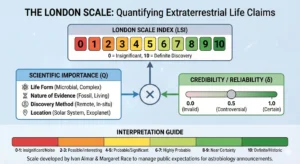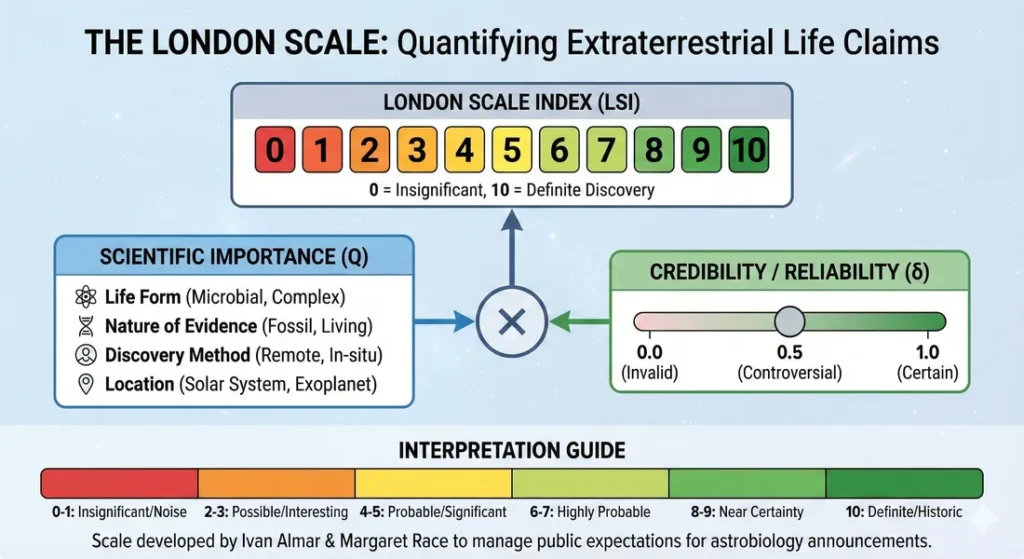
The London Scale is an analytical framework designed to quantify the scientific importance, validity, and potential consequences of any claimed discovery of extraterrestrial life. While other tools focus specifically on detecting intelligent alien signals (SETI), the London Scale is designed for astrobiology—addressing discoveries like fossilized microbes, atmospheric biosignatures on exoplanets, or subsurface organic life. The scale calculates an index (the London Scale Index or LSI) using a mathematical formula that multiplies the intrinsic scientific importance of the discovery (based on factors like how alien the life form is and its location) by the credibility of the evidence. This provides the scientific community and the media with a standardized way to evaluate whether a new “alien life” headline represents a robust, paradigm-shifting discovery or just a weak, unconfirmed anomaly.
The London Scale was first proposed in 2010 by Professor Iván Almár of the Hungarian Academy of Sciences, alongside astrobiologist Margaret Race. Almár introduced the concept during a landmark scientific meeting at the Royal Society in London—which gave the scale its name. It was created to fill a specific gap in the scientific community’s post-detection protocols. Previously, Almár and Jill Tarter had developed the Rio Scale in 2000 to quantify the significance of radio signals from intelligent aliens, but astrobiologists realized they needed a distinct tool for non-intelligent, microbial, or fossilized life discoveries, which present entirely different scientific and public communication challenges.