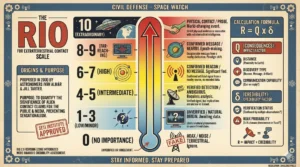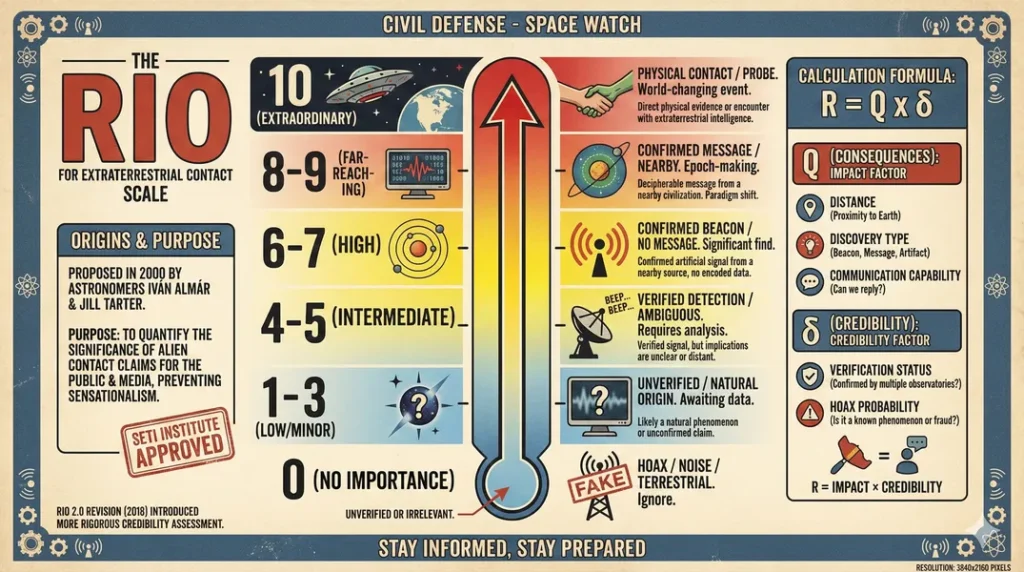
The scale mathematically calculates a score from 0 to 10 for a claimed extraterrestrial signal or artifact. In its classic formulation, the Rio Scale ($R$) is calculated by multiplying two primary terms: $R = Q \times \delta$.
$Q$ (Consequences): This measures the potential impact of the discovery. It is determined by assessing the type of phenomenon discovered, how it was discovered, and its distance from Earth (e.g., an artifact found in our solar system has a much higher $Q$ value than a radio signal detected thousands of light-years away).
$\delta$ (Credibility): This represents the assessed validity of the claim. It asks whether the signal is real, whether it could be a natural astrophysical phenomenon, or whether it might just be human interference or an instrumental glitch.
A final score of 0 means the event is of “Nil” importance (likely a hoax, mistake, or natural phenomenon), while a 10 represents an “Extraordinary” discovery that would forever change human history.
The primary value of the Rio Scale is objective communication. When a strange signal is detected (such as the famous “Wow! signal” or anomalies around Boyajian’s Star), it often generates massive media hype and public confusion. The Rio Scale gives scientists, journalists, and the public a quick, standardized way to assess whether a claim is worth paying attention to. By removing subjective hype, it prevents false alarms from damaging the credibility of SETI research, while ensuring that a genuinely significant detection is communicated with the appropriate weight.
The Rio Scale was proposed in October 2000 by Hungarian astronomer Iván Almár and American astronomer Jill Tarter (a pioneer of SETI research). They presented the concept at a SETI symposium held during the International Astronautical Congress in Rio de Janeiro, Brazil—which is how the scale got its name.
It was officially adopted by the SETI Permanent Committee of the International Academy of Astronautics (IAA) in 2002. The scale has undergone revisions over time; it was updated in 2011 to better account for interstellar messages and physical artifacts, and a major “Rio 2.0” revision was proposed by a team of researchers (including Duncan Forgan and Jason Wright) in 2018 to make the scale more objective and applicable to modern astronomy.
Special thanks to our friends at New Space Economy for providing the Infographic.